
HIGH-PERFORMANCE COMPUTATIONAL MINI-SATELLITE PLATFORM FOR EDGE AI APPLICATIONS FROM SPACE
Project Title: High-performance computational mini-satellite platform for EDGE-AI Applications from space
Acronym: EdgeAISat
Ref: INNEST/2023/180
Participating entities: I.I.U. de Telecomunicaciones y Aplicaciones Multimedia (ITEAM) de la Universidad Politécnica de Valencia (UPV), Dpto. de Ingeniería de Comunicaciones de la Universidad Miguel Hernández de Elche (UMH) y EmbEddEd Instruments and Systems S.L..
Duration:20/04/2023-31/12/2025
Responsible researcher: Dr. Vicente E. Boria Esbert
Abstract: The possibility of processing data in orbit by satellite platforms using advanced artificial intelligence (Edge AI) enables the rapid identification of changes (such as natural disasters) and critical information that needs to be transmitted, while simultaneously filtering out less relevant data. This reduces the required communication load and subsequent processing on Earth. Consequently, this leads to an optimization of real-time communications and, essentially, a reduction in reaction time.
Project Scope and Purpose: The overall objective of this strategic cooperation project is to develop a small satellite (smallsat) platform and deploy a demonstrator weighing between 50 and 75 kg, designed to implement advanced artificial intelligence (Edge AI) focused on processing images of the Earth’s surface from low Earth orbit (400 km to 1,000 km in altitude). The main challenges we face—and around which the project’s implementation tasks are centered—consist of achieving:
- A system with an average power of 100 W, consisting of solar panels, a storage system, and energy management and distribution to power all subsystems.
- A tankless water propulsion system, consisting of an electrochemical system that electrolyzes water into gaseous H2 and O2 used as fuel.
- An X-band (8–10 GHz) communications system consisting of a transceiver and antenna, featuring compact dimensions and low power consumption.
- A high-performance computer to run data-intensive applications, e.g., Artificial Intelligence (AI) applications.
- An Earth observation camera.
Key Results from the GAM ITEAM-UPV: X-Band Communications Subsystem.
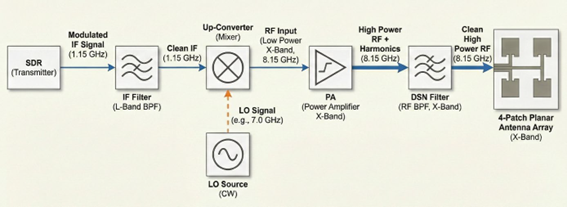
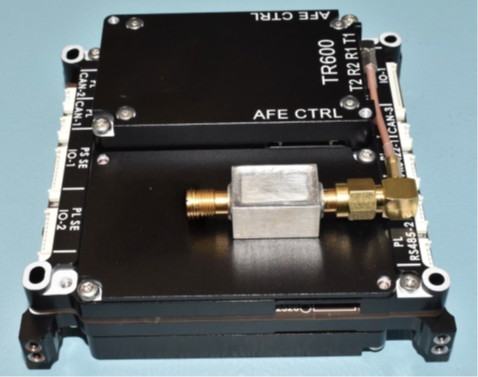
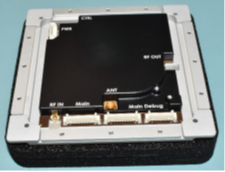
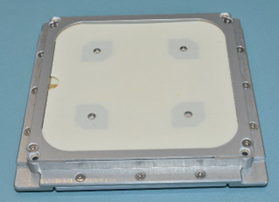
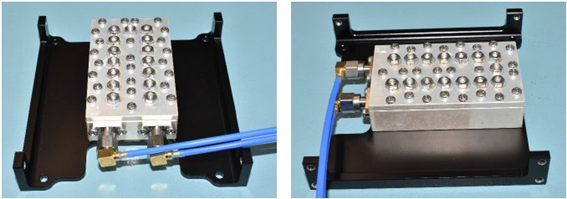
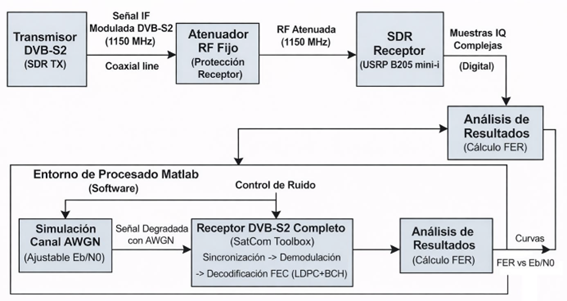
The GAM ITEAM-UPV team worked on the complete development of a communications subsystem comprising an SDR, an FPGA, and flight software that integrates DVB-S2. A front-end was designed to perform an IF (1.5 GHz) to X-band (8 GHz) conversion and amplify the signal for transmission at 4 W. This front-end was integrated with a very low-profile planar antenna, also developed to work in conjunction with the communications subsystem. Finally, to comply with DSN (Deep Space Network) regulations and prevent any signals that might interfere with these communications, a highly compact waveguide filter was designed.
- Key features:
- Transmission speed: up to 100 Mbps.
- Low power consumption and compact size (compatible with smallsats).
- Most relevant technical innovations:
- Flexible SDR architecture.
- Implementation of the complete communication protocol stack from the physical layer to the application layer (DVB-S2, IP, UDP).
- DSN filter in a folded waveguide to comply with ITU regulations.
- Low-profile, circularly polarized planar antenna with a 2×2 array (~12 dBi).
 |
 |
 |
 |
 |
 |
Financing entity: Programa Comunitat Valenciana Fondo Europeo de Desarrollo Regional (FEDER) 2021-2027
 |